Milwaukee history
Westown, the west side of downtown
Westown is downtown Milwaukee west of the river, with a library from 1898, bank vaults and an arena.
Photo: Douglas C. Green, Library of Congress.
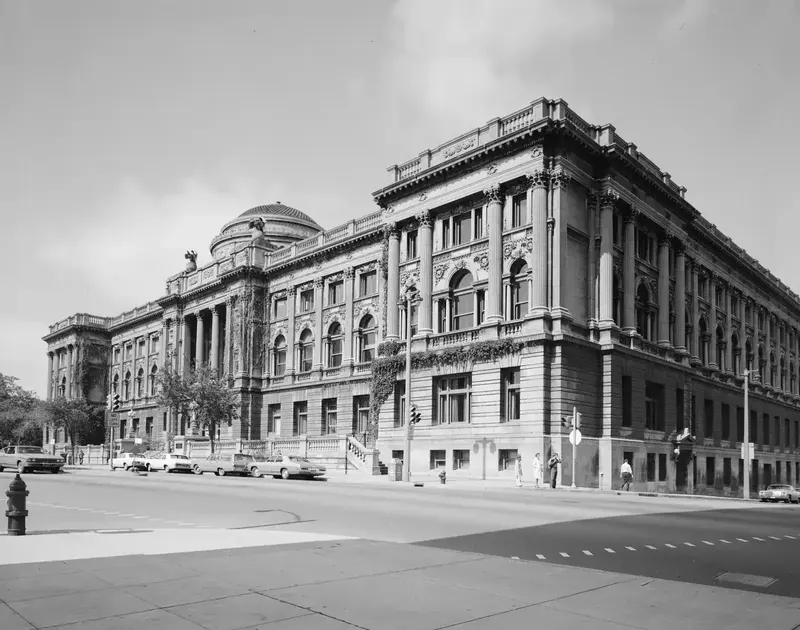
The Central Library in 1970, a Historic American Buildings Survey photograph in the public domain.
Photo: Douglas C. Green, Library of Congress.
Updated
About this story
Westown is downtown Milwaukee west of the river. It has the old Kilbourntown, a German shopping street, bank vaults you can step inside, a library from 1898 and an arena that fills a plaza.
Start on the west bank
Cross the Milwaukee River heading west and you step into Westown. The Westown Association describes a neighborhood in the heart of downtown, west of the river. It has sporting events, concert and theater venues, cultural institutions, hotels and the Old World Third Street Entertainment District.
That is a lot of ground, and it comes with a lot of history. This page walks through it in order. The stops are a rivalry that shaped the map, a German shopping street, a bank turned museum, department stores and streetcars, then the river, the arena and the markets.
Our own two restaurants sit on Third Street, and we say hello near the end. We are one stop among many in Westown. Start with the stories, pick a few places to see, and come eat when your feet need a rest.
Two towns, one river and a bridge war
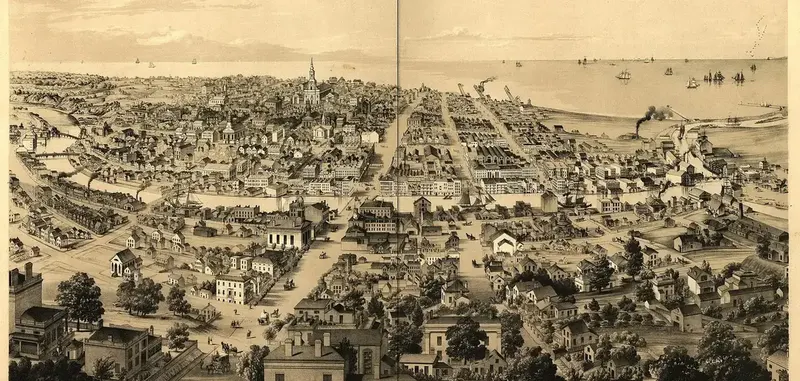
Milwaukee did not start as one city. Solomon Juneau began what became Juneautown on the east side of the river in 1818. Sixteen years later Byron Kilbourn founded Kilbourntown on the west bank, and George Walker founded Walker's Point to the south. Westown is on Kilbourn's side of the river.
The towns competed hard for settlers and trade. The Encyclopedia of Milwaukee says Kilbourn tried to isolate Juneautown. He laid out streets that did not match Juneautown's, published a map that made it look like a wasteland, and built a bridge that let travelers skip the ferry.
Then came the Bridge War. On May 3, 1845, a schooner ran into and partly wrecked the busy Spring Street bridge. Angry West Siders tore down their end of the Chestnut Street bridge on May 8, and East Siders sank half of the Spring Street bridge on May 28. The encyclopedia finds no evidence anyone was killed.
The fight pushed the towns toward peace. The three settlements merged into the City of Milwaukee on January 31, 1846, and Juneau became its first mayor. The feud is still visible. The encyclopedia and the Milwaukee Riverkeeper both trace the slanted angle of downtown's river bridges to street grids that were laid out not to line up.
The German commercial center
Kilbourntown filled up with German immigrants. The Encyclopedia of Milwaukee says that by 1840 German entrepreneurs were remaking commercial buildings on Third Street, west of the river, to serve a growing German community. Germans were the city's largest ethnic group for much of its history.
The National Register nomination for the Old World Third Street Historic District says that from the 1830s until World War I the area was one of downtown's most important commercial areas. It was home to some of the city's most important German-American merchants. Today it is the last remaining portion of that retail district.
Third Street sold nearly everything. The nomination lists saloons with upstairs halls rented to clubs and unions, drugstores, hardware and dry goods. It also lists Steinmeyer's, which it calls the city's largest combination wholesale and retail grocer of the 1800s. Even after Wisconsin Avenue became the main retail center, Third Street stayed important.
One business from that era is still there. Fred Usinger began his sausage company in 1880 on Third Street, and its six‑story building went up in 1906. VISIT Milwaukee calls the store a Milwaukee staple for over a century. For the block‑by‑block story, read our Old World Third Street guide.
“This is the last remaining portion of the original German retail district in the Kilbourntown plat of Milwaukee.”
The bank that kept its vaults
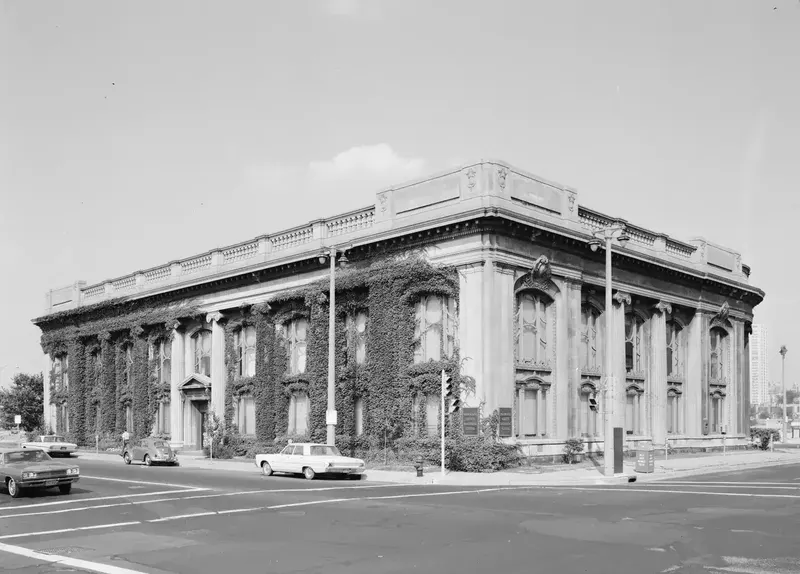
Where Third Street meets Kilbourn Avenue stands a stone building that looks like a bank because it was one. The Second Ward Savings Bank opened there on February 3, 1913, designed by Milwaukee architects Charles Kirchhoff and Thomas Leslie Rose. Today it is the Milwaukee County Historical Society.
The Historical Society says the bank earned the nickname the Brewers' Bank, because its board included brewers Phillip Best, Valentine Blatz and Joseph Schlitz. In 1928 it became part of First Wisconsin National Bank, which donated the building to Milwaukee County in 1965 for the Society's use.
The vaults are the main event. The Society says massive vaults sit on the basement, main floor and mezzanine levels, and that their doors, frames and fixtures were the building's largest single expense. Visitors can step inside one of them. That alone is worth the visit.
Look around while you are there. The Society says the interior is finished in black and white Italian marble, and that a restoration project begun in 2004 was completed in 2018. Check the Society's hours before you go, since days and closing times change through the year.
Shops and streetcars on Wisconsin Avenue
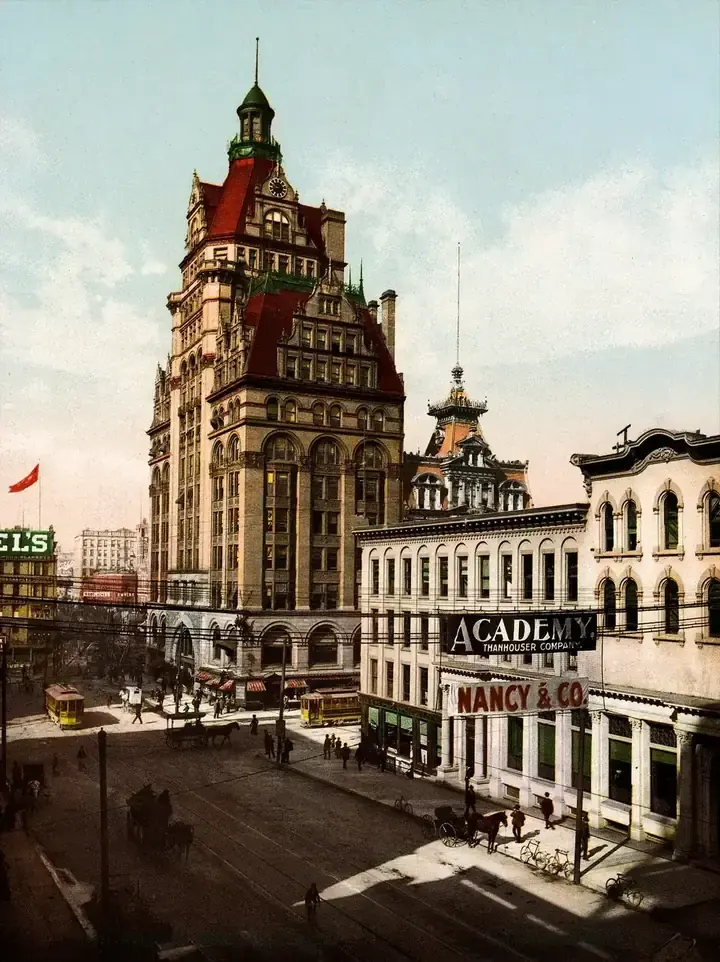
As downtown grew, Wisconsin Avenue became the main shopping street. Adam Gimbel opened his first Gimbels in Milwaukee in 1887, on Wisconsin Avenue between the river and Plankinton Avenue. Urban Milwaukee says the white terra cotta building that remains there was completed in 1925.
Streetcars carried the shoppers. Milwaukee's first electric streetcar ran on April 3, 1890. Urban Milwaukee notes that Gimbels and the Boston Store stood at busy trolley crossings on Wisconsin Avenue, at Plankinton Avenue and at Fourth Street. Third Street had its own anchor, Schuster's, which opened in 1884.
The old streetcars ran their last trip on March 2, 1958. Today the avenue still works as a main street. Offices, hotels, a food hall and the Night Market are all within a few blocks of each other, so you can park the car once and walk.
A library and a theater row
The Central Library opened on October 3, 1898, in a block‑long limestone building on West Wisconsin Avenue. Ferry and Clas of Milwaukee won a national competition that drew seventy‑four entries, including one from Frank Lloyd Wright. The building is on the National Register of Historic Places.
Step inside and look up. VISIT Milwaukee describes a rotunda dome overhead and a mosaic floor underfoot. It makes a quiet stop between the avenue's busier ones, and a good place to get out of the weather.
Westown is also theater country. The Miller High Life Theatre dates to 1909, and the Riverside Theater opened in 1928 on West Wisconsin Avenue. The Warner Grand Theater opened in 1931 and is now the Milwaukee Symphony Orchestra's Bradley Symphony Center.
The river and the RiverWalk
The Milwaukee River gives Westown its eastern edge. VISIT Milwaukee says the RiverWalk runs along both sides of the river from the site of the former North Avenue Dam through downtown and the Historic Third Ward to Lake Michigan. It has 3.1 miles of restaurants, brewpubs, shops and nightlife.
The idea is old. The Encyclopedia of Milwaukee says city planners first imagined a RiverWalk in the early 1900s. A segment was built outside the Gimbels department store in the late 1920s. In the 1980s Mayor Henry Maier revived the idea, and in the 1990s a west bank walkway went in from Clybourn Street to Pleasant Street.
Today you can stroll it, paddle beside it or take a boat tour. VISIT Milwaukee points to the Bronze Fonz statue, public art, bridges made for photos and riverside dining. It notes that the path is accessible, with several lifts for visitors who need them.
Fiserv Forum and the Deer District
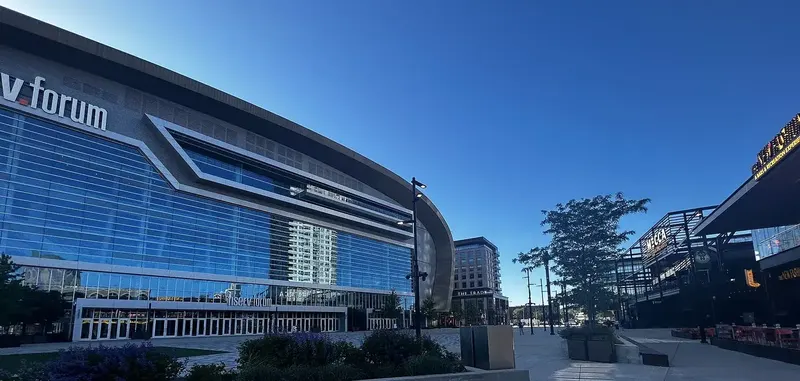
The big modern landmark is the arena. Fiserv Forum opened in 2018 as home of the Milwaukee Bucks and Marquette University men's basketball. The Encyclopedia of Milwaukee says its interior uses reclaimed wood and Cream City brick as a nod to Milwaukee's built heritage.
Around it grew the Deer District, a thirty‑acre entertainment block that the encyclopedia calls the largest development project ever undertaken in downtown Milwaukee. VISIT Milwaukee says some 65,000 fans packed the plaza in 2021 for the watch party celebrating the Bucks' NBA title.
You do not need a ticket to enjoy it. VISIT Milwaukee lists restaurants, breweries, a beer garden with a 40-foot LED screen, and plaza events such as Fitness on the Plaza and summer concert and movie nights. Bring comfortable shoes and an appetite.
Markets, indoors and out
The Milwaukee Night Market turns West Wisconsin Avenue into an open‑air market and dance floor on summer evenings. NEWaukee founded it in summer 2014, and the Westown Association took it over in 2021. The market says it has grown to draw more than 100,000 attendees each year.
The 2026 schedule listed monthly evenings from 5 to 9 p.m. Dates change from year to year, so check the official page before you plan around one. Wear comfortable shoes, because you will be on your feet.
For a market under a roof, try the 3rd St. Market Hall at 275 West Wisconsin Avenue. It opened in October 2021, and its own site invites you to explore twenty‑plus food vendors. Usinger's deli counter on Third Street is the old‑fashioned version of the same idea.
Westown through the years
1818
Juneau starts Juneautown
Solomon Juneau begins the settlement that becomes Juneautown, on the east side of the Milwaukee River. It is the first of three rival settlements. Source: Encyclopedia of Milwaukee.
1834
Kilbourntown is founded
Byron Kilbourn founds Kilbourntown on the west bank, across from Juneautown. George Walker founds Walker's Point to the south in the same year. Source: Encyclopedia of Milwaukee.
1840
Third Street turns German
By 1840, German immigrant entrepreneurs are remaking commercial buildings on Third Street, west of the river, to serve the growing German community there. Source: Encyclopedia of Milwaukee.
1845
The Bridge War
A schooner wrecks part of the Spring Street bridge on May 3. Mobs on both sides then tear down or sink bridges, with no known deaths. Source: Encyclopedia of Milwaukee.
1846
One city at last
The three settlements merge into the City of Milwaukee on January 31, 1846, and Solomon Juneau is elected its first mayor. Source: Encyclopedia of Milwaukee.
1880
Usinger's begins
Fred Usinger starts his sausage business on Third Street, on the site of a butcher shop. Its six‑story building follows in 1906. Source: National Register nomination.
1887
Gimbels opens
Adam Gimbel opens his first Gimbels emporium in Milwaukee, on Wisconsin Avenue between the river and Plankinton Avenue, long before the chain grew nationwide. Source: Urban Milwaukee.
1890
Electric streetcars arrive
Milwaukee's first electric streetcar runs on April 3, replacing horse‑drawn cars and changing how shoppers reach Wisconsin Avenue and Third Street. Source: Urban Milwaukee.
1898
Central Library opens
The Milwaukee Public Library opens its Central Library on October 3 at 814 West Wisconsin Avenue, a design by Ferry and Clas of Milwaukee. Source: Milwaukee Public Library.
1913
A bank opens on Third
The Second Ward Savings Bank opens on February 3 in a new stone building with large vaults. It now houses the county historical society. Source: Historic American Buildings Survey.
1931
Warner Grand opens
The Warner Brothers chain opens the Warner Grand Theater on Wisconsin Avenue. It becomes the Milwaukee Symphony's Bradley Symphony Center in 2021. Source: VISIT Milwaukee.
1958
The last streetcar
The last Milwaukee streetcar runs on March 2, 1958, ending the old system after nearly seven decades of electric service. Source: Urban Milwaukee.
1965
The bank becomes a museum
First Wisconsin National Bank donates the former Second Ward Savings Bank to Milwaukee County for the Historical Society's headquarters. Source: Historic American Buildings Survey.
2018
Fiserv Forum opens
The arena opens as home of the Bucks and anchors the thirty‑acre Deer District, a downtown development project the encyclopedia calls the largest ever. Source: Encyclopedia of Milwaukee.
Things to do now
Milwaukee County Historical Society
Step inside a bank vault in a 1913 bank building and see the exhibits. Check hours before you go.
Usinger's Famous Sausage
Visit the historic deli on Third Street and take home sausage and deli meats. Check the site for store hours.
Milwaukee Night Market
A free outdoor evening market on West Wisconsin Avenue, produced by the Westown Association. See the site for dates.
3rd St. Market Hall
A food hall at 275 West Wisconsin Avenue with twenty‑plus food vendors, a beer wall and games.
Milwaukee RiverWalk
3.1 miles along both sides of the river, with public art, bridges, boat tours and riverside dining.
Deer District
The plaza and restaurants around Fiserv Forum, with year‑round events. Check the calendar for game days.
Our corner of Westown
Oak Barrel Public House
A Third Street pub in a Cream City brick building, part of the Westown dining and nightlife mix that VISIT Milwaukee describes.
Who's on Third
A Third Street sports bar, listed by VISIT Milwaukee among the places to catch a game in Westown.
Sports bar
See Who's on Third (Who's on Third)
Where these facts come from
Westown Association 1 fact
Milwaukee Night Market 2 facts
3rd St. Market Hall 1 fact
Encyclopedia of Milwaukee 5 facts
Milwaukee Riverkeeper 1 fact
Wisconsin Historical Society 1 fact
National Park Service 1 fact
Library of Congress 1 fact
Milwaukee County Historical Society 2 facts
Urban Milwaukee 2 facts
Milwaukee Public Library 1 fact
Visit Milwaukee 5 facts
- Usinger's store as a Milwaukee staple; Westown pubs and sports bars
- The central library's rotunda dome and mosaic floor
- Theaters, Miller High Life 1909, Riverside 1928, Warner Grand 1931 and Bradley Symphony Center
- The RiverWalk runs both sides of the river, 3.1 miles
- 65,000 fans at the 2021 Bucks watch party
More Milwaukee guides
Old World Third Street
The street and its German roots.
The building at 1033
A hardware store, now Oak Barrel.
Come see Westown
Text us the date and how many are coming. We line up the rest.